


DPDP Consent Managers are becoming an essential part of every Indian enterprise’s privacy strategy as businesses prepare for compliance with the Digital Personal Data Protection (DPDP) Act. With DPDP compliance becoming mandatory, choosing the right DPDP Consent Manager is no longer optional for businesses handling personal data.
What is a DPDP Consent Manager?
A DPDP Consent Manager is a platform that helps businesses collect, manage, update, and record user consent for processing personal data in accordance with the Digital Personal Data Protection (DPDP) Act, 2023. Unlike simple consent collection, which only captures a user’s approval at a single point in time, a DPDP Consent Manager oversees the entire consent lifecycle—from purpose-based consent collection and secure record keeping to consent updates and withdrawal. This enables organizations to maintain audit-ready records, honour Data Principal requests, and demonstrate compliance with the DPDP Act.
What is the DPDP Act?
The Digital Personal Data Protection (DPDP) Act, 2023 is India’s primary law governing the collection, processing, storage, and protection of digital personal data. It gives individuals (called Data Principals) greater control over how their personal information is used while requiring organizations (Data Fiduciaries) to obtain clear, informed, and purpose-specific consent before processing personal data. The Act also grants users the right to withdraw consent, request corrections, and seek grievance redressal.
Why Businesses Need DPDP Consent Managers
As organisations prepare for DPDP compliance, DPDP Consent Managers have become essential for managing the complete consent lifecycle efficiently. They automate consent collection, allow users to easily withdraw or update their consent, and ensure that consent is captured for specific purposes as required by the DPDP Act. These platforms also maintain detailed audit logs, support Data Principal Rights requests, and offer multi-language interfaces to improve user experience.
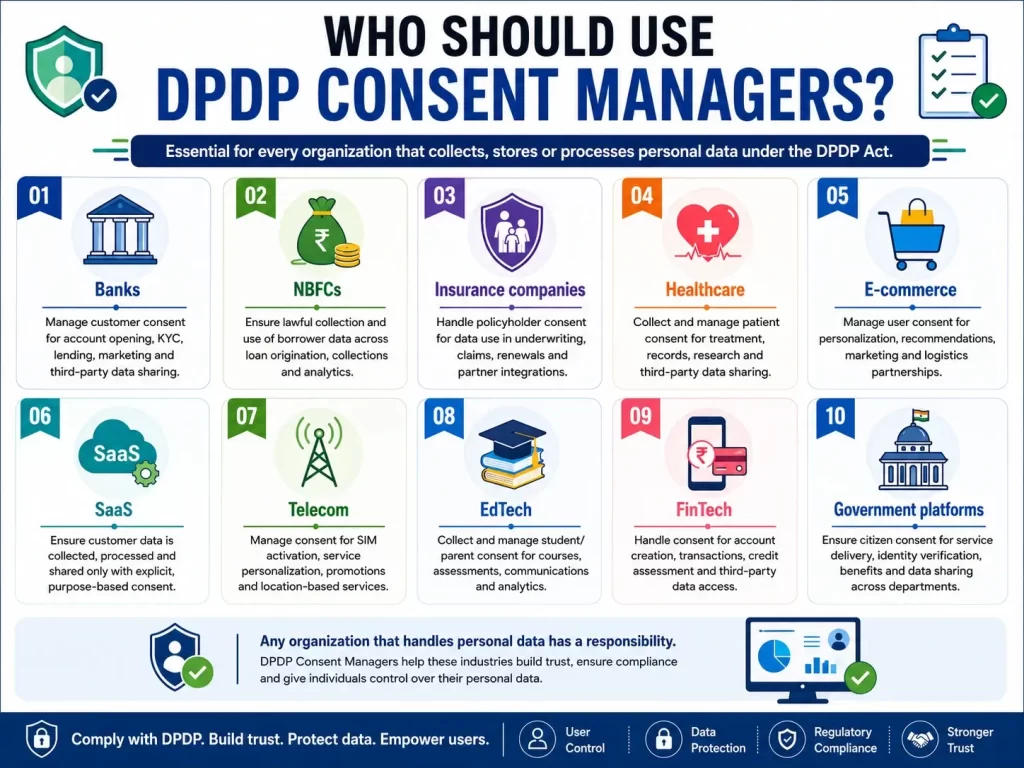
Consent capture has been part of digital interactions for years. Customers “agreed” to jargon-filled forms without necessarily understanding what they were signing up for, clicking through in pursuit of a smoother experience. On the other end, companies used that data to optimise their digital offerings, and in some cases, it leaked out to third-party tools and vendors they never fully vetted. Incidents like these chip away at customer trust, one silent data-sharing agreement at a time.
The DPDP Act changes that equation. Customers now have greater control over their personal data, including the ability to withdraw consent whenever they choose. The problem is that most enterprises were never built for this. Customer data is scattered across CRMs, loan origination systems, marketing stacks, and data warehouses, which makes it genuinely hard to track who agreed to what, let alone let them revoke it on demand. With the compliance deadline set for May 2027, businesses need a consent architecture that captures consent, classifies it, tracks it over time, and lets customers revoke without a support ticket. Failing to fulfill this garners more than reputational damage, with the DPDP Act’s penalties going up to ₹250 crore for non-compliance.
Here are seven DPDP Consent Managers helping Indian businesses manage the consent lifecycle without the manual toil, while building the kind of trust DPDP was designed to protect.
-
Neokred (Blutic)
Neokred’s Blutic was built specifically around the DPDP Act, and it’s designed to manage the entire consent management lifecycle. The platform automatically classifies cookies into necessary, functional, marketing, and analytics buckets, and lets businesses deploy consent banners matched to their brand tone, language, and visual identity across regions without needing technical expertise. It covers every domain and subdomain a business runs from a single dashboard and keeps compliance records audit-ready at all times.
What sets Blutic apart is how far it’s moved beyond consent capture alone. Its recent GRC (Governance, Risk, and Compliance) expansion turned it from a standalone consent manager into a full compliance layer, adding real-time risk monitoring, anomaly detection, and automated regulatory reporting into the same dashboard businesses already use for consent. It also supports time-based consent that expires or renews on its own, an open-source login system, and a one-click OAuth login for onboarding. For businesses that want consent management and broader compliance risk handled in one place, Blutic is a good choice.
-
Perfios
Perfios brought its financial services expertise into a dedicated DPDP Suite that offers more than just consent management. The platform bundles data discovery and classification, automated Records of Processing Activities (RoPA), consent governance, data principal rights management, cookie consent, and database activity monitoring into one system. Consent is captured at a granular level, down to individual data points like name, email, or phone number, and can be revoked by users as easily as it was given. With native support across 22 scheduled languages and a cloud-native architecture built for high transaction volumes, it’s designed for enterprises, particularly in BFSI, that need consent tied directly into a broader data governance framework.
-
Redacto
Redacto is an India-first, AI-powered platform that treats consent as one piece of a larger privacy operations problem. In addition to collecting and tracking consent, it connects that data to DSAR (Data Subject Access Request) handling, vendor risk assessments, and breach workflows. It helps businesses manage the operational layer many already have policies for but struggle to manually run. It supports multilingual consent workflows and offers a large library of integrations, which cuts down deployment time for businesses whose consent data is currently spread across disconnected systems. The tool is the best choice for companies that want one platform managing the full consent-to-compliance pipeline instead of separate tools for each function. It has proved across industries, including BFSI, Healthcare, Pharma, Manufacturing, and more.
-
Consentin by Leegality
Built by Leegality, a company with two decades in digital documentation and e-signing, Consentin was among the first platforms in India built specifically for DPDP-era consent governance. It allows businesses to sync consent records across internal and third-party databases through webhooks and APIs, and gives customers a self-serve Privacy Centre to update or withdraw consent without raising a request. When consent is withdrawn, it can automatically trigger deletion instructions to connected internal and external systems, closing a loop many platforms leave manual. It also runs data discovery across structured and unstructured systems, maps data lineage to flag downstream risk, and assesses third-party vendor compliance. As it’s built by a legal team rather than a pure engineering one, it leans into consent as a legal instrument first, with the technical workflow built around that.
-
Surepass
Surepass takes a more straightforward, implementation-first approach to DPDP consent management. It allows businesses to collect consent directly from users before gathering any personal data, tracks that consent with a detailed audit trail, and gives users the ability to withdraw it at any point. The platform also offers an entire suite of tools to manage consent from collection to withdrawal, in a single interface. The stack includes purpose-based consent collection; a centralized consent repository to store records, Data Subject Rights Management (DSR) for consent edits, deletion and withdrawal; DPIA and third-party risk management, to name a few. It’s positioned for sectors that handle high volumes of personal data, including banking, healthcare, insurance, and telecom and relies on a simple API and interface to keep integration easy.
-
Complynz
Complynz targets a different part of the market: startups and mid-sized businesses that need DPDP compliance but can’t justify enterprise-grade pricing. It covers the full consent lifecycle from collection, purpose-specific tracking, audit trails to withdrawal across web, mobile, email, and offline channels, unifying all of it into a single view per user. It supports 22 scheduled languages plus Hinglish, and its consent analytics track opt-in and opt-out trends to help businesses spot friction points in real time. Pricing starts as low as ₹10,000/month, which makes it one of the more accessible entry points for companies just beginning to build out DPDP compliance rather than retrofitting an existing enterprise tool.
-
BigID
BigID is a platform that leads with data discovery, and consent management sits on top of that foundation. The platform is built to identify and classify personal and sensitive data across large, complex, and often unstructured data environments, which makes it a fit for enterprises that don’t yet have full visibility into where their customer data lives before they can even think about managing consent for it. It supports GDPR, CPRA, Law 25, LGPD, GPC, IAB TCF 2.2, and Google Consent Mode v2 and this self-service consent management is primarily built for privacy, marketing, and compliance teams. For organizations whose biggest DPDP gap is knowing what data they hold and where, rather than managing consent for data they’ve already mapped, BigID’s discovery-first approach fills a different need than the consent-first platforms on this list.
How to Choose the Right DPDP Consent Managers
Choosing the right DPDP Consent Manager depends on your business size, industry, compliance requirements, and existing technology stack. Look for a platform that not only simplifies consent management but also scales with your organisation’s future privacy and regulatory needs.
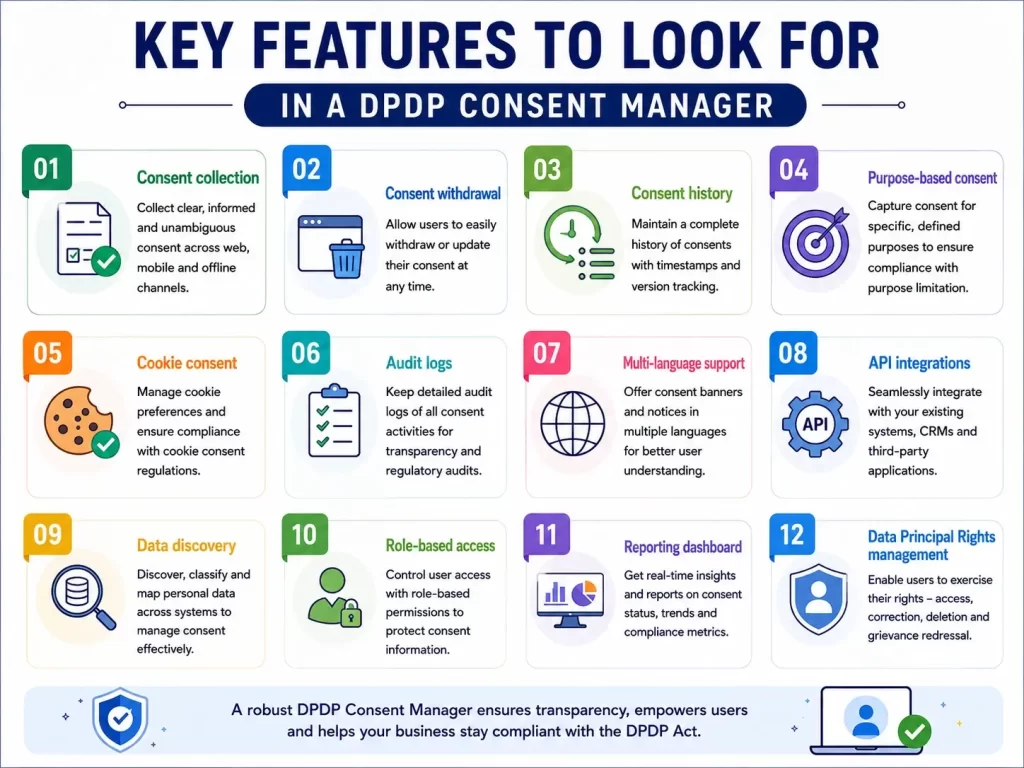
- Ease of Integration: Seamlessly connects with your existing applications and workflows.
- API Support: Offers robust APIs for quick and flexible implementation.
- Consent Withdrawal: Allows users to easily update or revoke their consent.
- Multi-language Support: Enables consent collection in multiple Indian languages.
- Scalability: Supports growing data volumes and expanding business operations.
- Cookie Consent Management: Helps manage website cookie preferences and compliance.
- Data Discovery: Identifies and classifies personal data across systems.
- Data Subject Rights Management: Simplifies handling of access, correction, deletion, and consent requests.
- Reporting & Analytics: Provides dashboards and compliance reports for audits.
- Pricing: Choose a solution that fits your budget while meeting your compliance requirements.
| Platform | Best For | Key Strength |
|---|---|---|
| Neokred Blutic | Enterprises | DPDP + GRC |
| Perfios | BFSI | Data governance |
| Redacto | Large enterprises | Privacy operations |
| Consentin | Legal workflows | Privacy Centre |
| Surepass | API-first businesses | Fast implementation |
| Complynz | Startups & SMBs | Affordable |
| BigID | Large organisations | Data discovery |
Conclusion
As Indian businesses prepare for DPDP compliance, investing in the right DPDP Consent Manager can simplify regulatory obligations while improving customer trust. Choose a solution that supports consent collection, withdrawal, audit trails, and Data Principal Rights while meeting your organisation’s compliance and business requirements. Evaluate your business needs carefully before selecting the top from the list of DPDP Consent Managers that aligns with your compliance and growth goals.
FAQs
Q1. How is a DPDP Consent Manager different from a cookie consent platform?
A cookie consent platform primarily manages user consent for website cookies and tracking technologies. A DPDP Consent Manager goes much further by managing the entire consent lifecycle for personal data, including purpose-based consent, consent withdrawal, audit trails, Data Principal Rights, and compliance with the DPDP Act.
Q2. Can a DPDP Consent Manager integrate with CRM and ERP systems?
Yes. Most modern DPDP Consent Managers offer APIs and integrations with CRM, ERP, marketing automation, customer support, and other business applications. This ensures consent records remain synchronised across systems and helps organisations maintain consistent DPDP compliance.
Q3.Is a DPDP Consent Manager mandatory under the DPDP Act?
The DPDP Act requires organisations to obtain and manage valid user consent where applicable, but it does not mandate a specific software platform. However, using a DPDP Consent Manager makes it much easier to maintain consent records, handle withdrawals, and demonstrate compliance during audits.
Also read – Top 7 Indian Tools for Seamless DPDP Compliance in 2026
Join us on LinkedIn for quick updates – FYI9 News LinkedIn