


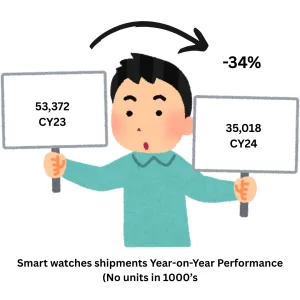
The mid-range smartwatch segment in India is facing its toughest challenge yet, as competition and shifting consumer demand push this once-thriving category into decline. Positioned between INR 2,000 and INR 10,000, the segment has witnessed a sharp 34.4% year-over-year drop in shipments, falling from 53.3 million units in CY23 to just 35 million in CY24. The downward trend has now stretched across three consecutive quarters, with Q4 CY24 recording an 8.7% fall to 25.9 million units.
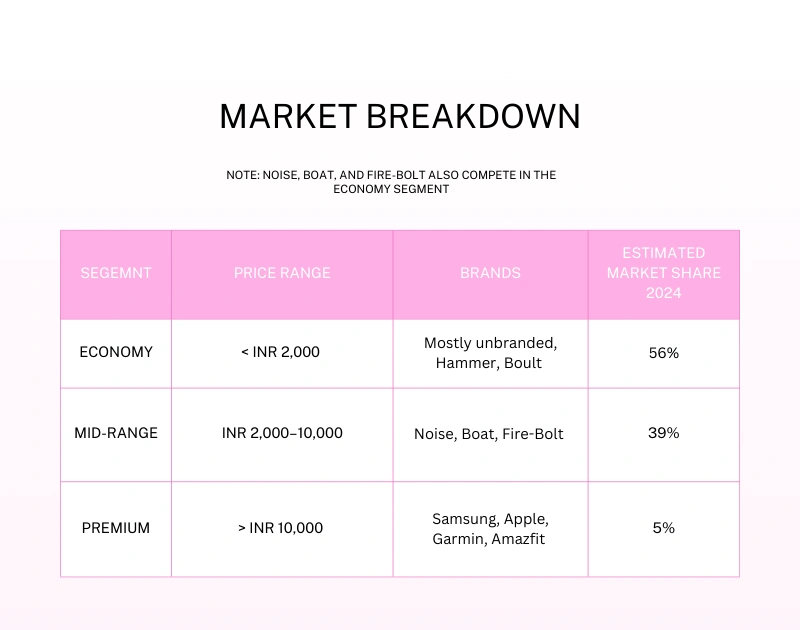
Smartwatches Market Breakdown in India
What’s Driving the Decline?
While premium brands like Apple, Samsung, and Garmin continue to expand their presence, growing unit share from 2.1% to 2.8% between CY23 and CY24—mid-range players are finding it increasingly difficult to prove their worth.
The slowdown stems from several key factors. First, the novelty of smartwatches has faded, especially for casual buyers who see little day-to-day benefit. Second, health and fitness enthusiasts are migrating to premium wearables such as high-end watches and emerging devices like smart rings, which saw shipments jump from 112,000 to 323,000 in CY24 (a 186% increase). Third, repeat purchases remain low, as many early adopters feel mid-range devices have not evolved meaningfully enough to warrant upgrades.
The issue is compounded by a sense of sameness across products. Most mid-range devices continue to rely on generic LED screens, basic health sensors, and off-the-shelf components sourced from China. Instead of innovation, brands have leaned on superficial updates such as new strap colors or minor display tweaks.
Feature Comparison Across Segments
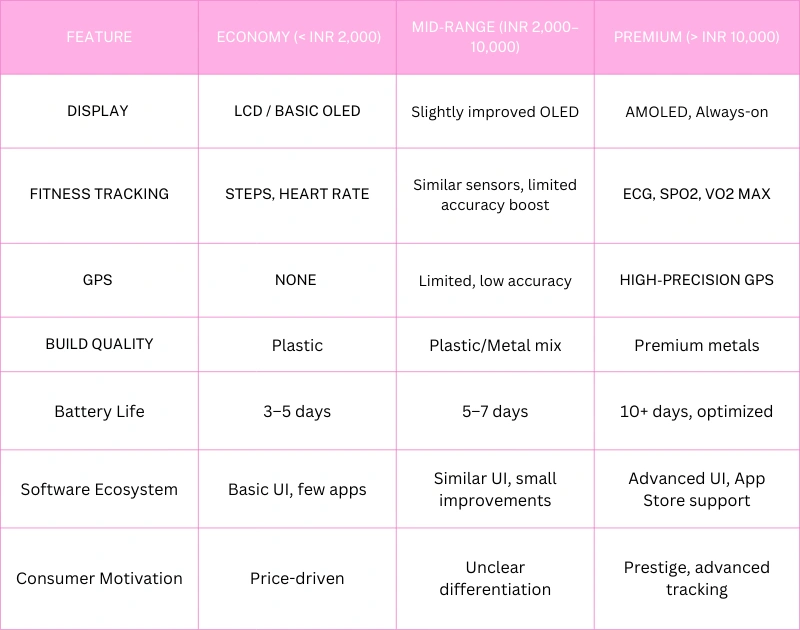
Modern consumers now expect reliable health features such as ECG, SpO2, and advanced sleep tracking, which mid-range smartwatches often fail to deliver. Aesthetics also play a crucial role, but here too, most devices lack originality, with nearly identical designs crowding the shelves.
The Way Forward for Mid-Range Players
To survive, mid-range brands must rethink their playbook. Instead of chasing smartphone-like functionality, they need to carve out niche value propositions that stand above budget devices and still feel competitive next to premium options.
One way is through strategic partnerships. For example, Fossil worked with Google on Wear OS, while Noise has teamed up with Bose for audio features. Collaborations with chipset makers or health-tech firms could further boost differentiation. Another approach is specialization—focusing on areas like sports-specific models, fashion-led designs, or devices tailored for particular industries such as healthcare or workplace safety.
Companion apps also represent an underutilized opportunity. Deep integration with iOS and Android, native support for popular health platforms, and unique cross-device functionalities could help build long-term user loyalty.
Finally, mid-range smartwatch makers could explore design collaborations with fashion houses, limited-edition releases, and customization options that appeal to style-conscious buyers. Innovation in form factor—moving beyond the traditional watch aesthetic—could also provide a fresh competitive edge.
The mid-range market is at a crossroads. Brands unwilling to evolve risk further erosion of market share. The winners will be those who make bold bets—whether by moving upmarket with precision health devices or redefining the category with hybrid, style-first wearables. The future belongs to companies that can clearly answer the consumer’s question: why choose this smartwatch over both a budget model and a premium brand?
The above article is authored by Ganesh Shewatkar (Senior Consultant), and Shubham Sanghavi (Management Consultant) at Avalon Consulting.
Check this interesting blog – How Blockchain Could Revolutionize Digital Media
For any authored article/press release and interview opportunities please write to us at pr@fyi9.com.