


The logistics industry is undergoing rapid digital transformation, and at the center of this change is digital twin in logistics, a groundbreaking technology that creates virtual replicas of assets, processes, and entire supply chains. By harnessing IoT data, AI, and machine learning, logistics companies can simulate real-world operations, predict outcomes, and optimize performance at scale. This shift is enabling organizations to build smarter warehouses, resilient supply chains, and more sustainable logistics networks.
Today, some of the world’s leading IT and engineering service providers are driving this digital twin revolution in logistics, offering next-generation solutions that combine predictive analytics, process automation, and digital engineering. Below, we explore the top global players leading the charge.
-
Creative Synergies Group
Creative Synergies Group is a global digital innovation solutions provider specializing in digital engineering, embedded systems, and software technologies. In the logistics domain, the company leverages IoT, AI, and machine learning to develop connected, intelligent assets that support Industry 4.0 adoption.
Its digital twin approach emphasizes a “convergence of digital engineering,” enabling logistics companies to replicate warehouses, transport fleets, or even manufacturing plants. By creating highly detailed simulations, Creative Synergies helps logistics operators optimize energy usage, reduce downtime, and improve overall supply chain efficiency.
-
Tata Consultancy Services (TCS)
TCS has built strong momentum in the logistics digital twin space with its proprietary TCS TwinX™ platform. Designed for supply chain network optimization, this enterprise platform shifts decision-making from experience-based to evidence-based models.
Through real-time simulations, logistics companies can test strategies, measure the impact of disruptions such as natural disasters or market volatility, and identify optimal network configurations. TCS TwinX™ enables organizations to achieve agility, resilience, and scalability, positioning TCS as a leader in digital twin logistics transformation.
You may also like – Top Indian AI Leaders To Watch Out For
-
Accenture
Accenture is known for its large-scale digital transformation projects, and logistics is no exception. A notable partnership with KION GROUP AG and NVIDIA highlights its strength in building AI-powered digital twins for warehouses. Using NVIDIA Omniverse, Accenture develops simulations that optimize warehouse layouts, robot deployment, and safety standards without interrupting real-world operations.
Additionally, Accenture integrates digital twins with ERP systems to offer end-to-end visibility into supply chain functions. This creates a dynamic environment where logistics leaders can test and refine operations before implementing them on the ground, reducing costs and enhancing efficiency.
-
Infosys
Infosys plays a significant role in advancing digital twin technology for the air cargo sector. Its multi-layered approach includes:
- Component twins for monitoring individual parts such as cargo motors.
- Asset twins for managing combined systems like ramp vehicles and cooling tunnels.
- Process twins for simulating the entire cargo journey from door-to-door.
Infosys’s digital twin models are powered by IoT, AI, and visual analytics, allowing logistics operators to conduct predictive maintenance, reroute shipments in real time, and improve workforce allocation. This holistic approach makes Infosys a standout in aviation logistics and global cargo operations.
-
HCLTech
HCLTech offers a full lifecycle of Digital Twin Services for logistics enterprises, ranging from consulting and design to deployment and maintenance. A flagship solution is SCMTwin, a cognitive twin platform that predicts supply chain dynamics to improve sourcing, resilience, and visibility.
For logistics companies, HCLTech’s offerings deliver robust simulations to optimize fleet performance, reduce downtime, and boost productivity. Its scalable solutions make it an attractive partner for businesses seeking long-term digital supply chain transformation.
-
Capgemini
Capgemini emphasizes a system-of-systems approach to digital twins. Rather than limiting the scope to a single unit, Capgemini combines digital replicas of robotic arms, production lines, and factories into a unified supply chain model.
By leveraging AI, 5G, and data integration technologies, Capgemini helps logistics enterprises create interconnected supply chain networks with higher predictability and resilience. Its research-driven strategies make it an enabler for companies exploring enterprise-wide adoption of digital twin solutions.
-
Wipro
Wipro’s digital twin platform connects Product Lifecycle Management (PLM) systems with IoT-powered operations. This integration creates a “digital thread” that spans the entire product lifecycle, enabling logistics enterprises to manage assets more effectively.
In logistics, Wipro’s strength lies in predictive maintenance and fleet management, where continuous monitoring allows for early detection of performance issues. Its platform supports remote monitoring and control, delivering significant cost savings and operational efficiency for large-scale logistics operations.
Comparative Analysis: Digital Twin Leaders in Logistics
While all seven companies are driving the digital twin revolution, their approaches to digital twin in logistics highlight distinct strengths. Creative Synergies Group focuses on digital engineering and Industry 4.0 enablement, while TCS delivers resilience through its TwinX™ platform for supply chain optimization. Accenture specializes in AI-powered warehouse twins with NVIDIA, whereas Infosys offers multi-layered solutions for the air cargo sector. HCLTech emphasizes predictive modeling with SCMTwin, Capgemini builds system-wide integrations powered by AI and 5G, and Wipro excels in fleet and lifecycle management with its digital thread. Together, these players define the diverse strategies shaping the future of digital twin in logistics.
- Creative Synergies Group stands out for digital engineering and Industry 4.0 readiness, making it ideal for companies seeking smart plant and warehouse engineering.
- TCS differentiates itself with TCS TwinX™, a platform dedicated to supply chain simulation and resilience.
- Accenture focuses on AI-powered warehouse twins, especially through collaborations with technology giants like NVIDIA.
- Infosys brings unique value to air cargo logistics, offering a multi-layered twin strategy (component, asset, and process).
- HCLTech emphasizes end-to-end supply chain decision-making with predictive modeling through SCMTwin.
- Capgemini highlights system-wide integration, creating a connected supply chain twin that scales across factories and global networks.
- Wipro excels in lifecycle management and predictive fleet monitoring, bridging PLM with IoT for full operational visibility.
The adoption of digital twin in logistics is no longer experimental, it is becoming mission critical for global enterprises. By combining IoT, AI, and advanced analytics, digital twins provide logistics operators with the tools to predict disruptions, enhance visibility, and optimize efficiency across supply chains. As global competition and customer expectations intensify, companies that invest in digital twin in logistics will lead the way in creating smarter, more agile, and sustainable logistics ecosystems for 2025 and beyond.
Comparative Table: Digital Twin Leaders in Logistics
| Company | Key Offering / Platform | Industry Focus | Strength in Logistics Use Case |
|---|---|---|---|
| Creative Synergies Group | Convergence of digital engineering | Industry 4.0, Manufacturing, Logistics | Smart plant engineering, warehouse simulation |
| TCS (Tata Consultancy) | TCS TwinX™ | Supply Chain, Logistics | Network optimization, resilience, real-time decision-making |
| Accenture | AI-powered digital twins (NVIDIA Omniverse) | Warehousing, Supply Chain | Warehouse design optimization, ERP integration |
| Infosys | Component, Asset & Process Twins | Air Cargo Logistics | Predictive maintenance, cargo journey optimization |
| HCLTech | SCMTwin Cognitive Twin | Supply Chain, Logistics | Predictive modeling, sourcing resilience |
| Capgemini | System-of-systems digital twins | Manufacturing & Supply Chain | Unified supply chain networks, AI & 5G integration |
| Wipro | Digital Thread (PLM + IoT) | Fleet & Asset Management | Predictive maintenance, lifecycle optimization |
FAQs on Digital Twin in Logistics
Question: What are digital twins in logistics?
Answer: Digital twins in logistics are virtual replicas of physical assets, processes, or supply chain networks. They allow logistics companies to simulate real-world scenarios, optimize operations, and improve decision-making by using real-time IoT, AI, and machine learning data.
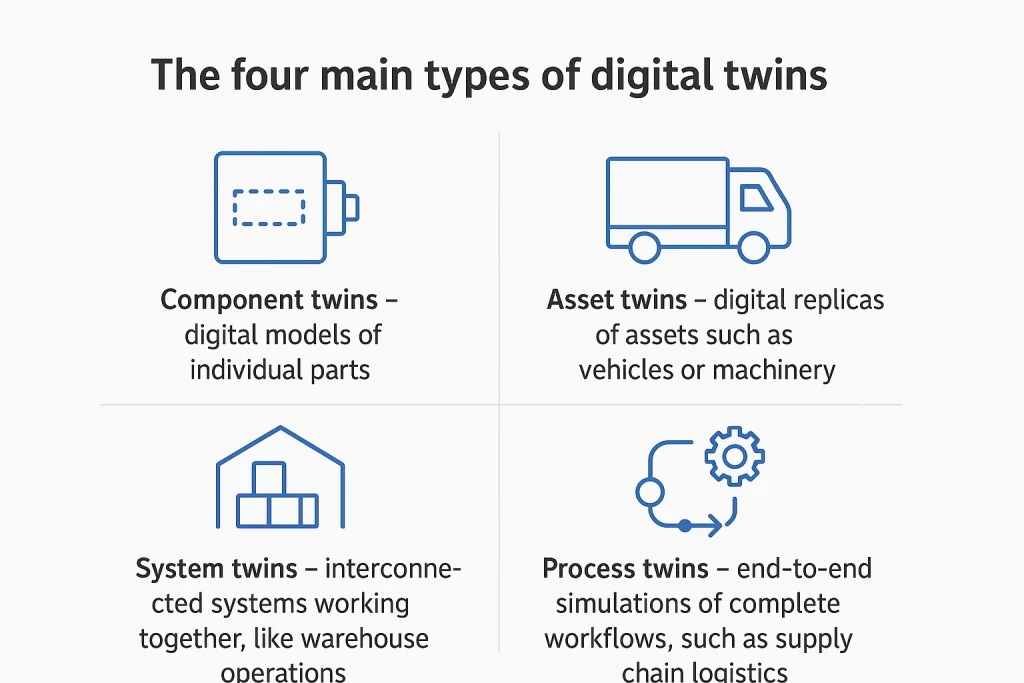
Question: What are the four types of digital twins?
Answer: The four main types of digital twins are:
- Component twins – digital models of individual parts.
- Asset twins – digital replicas of assets such as vehicles or machinery.
- System twins – interconnected systems working together, like warehouse operations.
- Process twins – end-to-end simulations of complete workflows, such as supply chain logistics.
Question: What is a digital twin example?
Answer: A practical example of a digital twin in logistics is a warehouse twin. Using IoT sensors and AI, companies can simulate warehouse layouts, test robot deployment, and optimize safety procedures without disrupting actual operations.
Question: What is the role of digital twin in logistics?
Answer: The role of digital twin in logistics is to improve efficiency, resilience, and sustainability. It enables predictive maintenance, supply chain optimization, real-time rerouting of shipments, and proactive risk management. Ultimately, it empowers logistics companies to build smarter, more agile, and connected supply chains.
Connect with us on LinkedIn for quick updates